I Promised That Is Act of Indiscipline Did Not Occurred Again
| Battle of Blenheim | |||||||
|---|---|---|---|---|---|---|---|
| Office of the War of the Castilian Succession | |||||||
 Marshal Tallard, the French commander, surrendering to the Duke of Marlborough at Blenheim. | |||||||
| |||||||
| Belligerents | |||||||
Grand Brotherhood:
|
| ||||||
| Commanders and leaders | |||||||
|
| ||||||
| Strength | |||||||
|
| ||||||
| Casualties and losses | |||||||
|
| ||||||
| class=notpageimage| Location inside Germany Show map of Frg Battle of Blenheim (Europe) Prove map of Europe | |||||||


The Battle of Blenheim (German: Zweite Schlacht bei Höchstädt; French: Bataille de Höchstädt; Dutch: Slag bij Blenheim) fought on 13 August [O.Southward. 2 Baronial] 1704, was a major battle of the War of the Castilian Succession. The overwhelming Allied victory ensured the safety of Vienna from the Franco-Bavarian regular army, thus preventing the collapse of the reconstituted M Alliance.
Louis XIV of France sought to knock the Holy Roman Emperor, Leopold, out of the war by seizing Vienna, the Habsburg capital, and gain a favourable peace settlement. The dangers to Vienna were considerable: Maximilian Two Emanuel, Elector of Bavaria, and Marshal Ferdinand de Marsin'southward forces in Bavaria threatened from the west, and Align Louis Joseph de Bourbon, duc de Vendôme's large regular army in northern Italy posed a serious danger with a potential offensive through the Brenner Pass. Vienna was also under pressure from Rákóczi's Hungarian defection from its eastern approaches. Realising the danger, the Duke of Marlborough resolved to alleviate the peril to Vienna past marching his forces south from Bedburg to help maintain Emperor Leopold within the Grand Alliance.
A combination of charade and skilled administration – designed to conceal his true destination from friend and foe akin – enabled Marlborough to march 400 km (250 mi) unhindered from the Low Countries to the River Danube in five weeks. After securing Donauwörth on the Danube, Marlborough sought to engage Maximilian'southward and Marsin's ground forces before Marshal Camille d'Hostun, duc de Tallard, could bring reinforcements through the Black Wood. The Franco-Bavarian commanders proved reluctant to fight until their numbers were accounted sufficient, and Marlborough failed in his attempts to force an engagement. When Tallard arrived to eternalize Maximilian's ground forces, and Prince Eugene of Savoy arrived with reinforcements for the Allies, the two armies finally met on the banks of the Danube in and effectually the pocket-size hamlet of Blindheim, from which the English "Blenheim" is derived.
Blenheim was i of the battles that altered the course of the war, which until then was favouring the French and Spanish Bourbons. Although the battle did not win the war, information technology prevented a potentially devastating loss for the Grand Alliance and shifted the state of war'south momentum, ending French plans of knocking Emperor Leopold out of the war. The French suffered catastrophic casualties in the battle including their commander-in-main, Tallard, who was taken convict to England. Earlier the 1704 campaign ended, the Allies had taken Landau, and the towns of Trier and Trarbach on the Moselle in grooming for the post-obit yr'south campaign into France itself. This offensive never materialised as the Yard Alliance's army had to depart the Moselle to defend Liège from a French counter-offensive. The war raged on for another decade before ending in 1714.
Groundwork [edit]
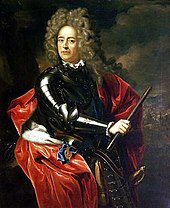
By 1704, the War of the Spanish Succession was in its fourth year. The previous year had been ane of successes for France and her allies, nigh especially on the Danube, where Align Claude-Louis-Hector de Villars and Maximilian II Emanuel, Elector of Bavaria, had created a direct threat to Vienna, the Habsburg capital.[2] Vienna had been saved by dissension between the two commanders, leading to Villars being replaced by the less dynamic Marshal Ferdinand de Marsin. All the same, the threat was even so real: Rákóczi's Hungarian defection was threatening the Empire's eastern approaches, and Align Louis Joseph, Duke of Vendôme'southward forces threatened an invasion from northern Italy.[3] In the courts of Versailles and Madrid, Vienna's autumn was confidently predictable, an event which would almost certainly have led to the plummet of the reconstituted 1000 Alliance.[iv]
To isolate the Danube from any Allied intervention, Align François de Neufville, duc de Villeroi's 46,000 troops were expected to pin the lxx,000 Dutch and British troops effectually Maastricht in the Low Countries, while General Robert Jean Antoine de Franquetot de Coigny protected Alsace against surprise with a farther corps.[ii] The just forces immediately available for Vienna's defence were Prince Louis of Baden's 36,000 men stationed in the Lines of Stollhofen to sentry Align Camille d'Hostun, duc de Tallard, at Strasbourg; and 10,000 men nether Prince Eugene of Savoy south of Ulm.[5] [6]
Both the Imperial Austrian Ambassador in London, Count Wratislaw, and the Duke of Marlborough realised the implications of the situation on the Danube. The Dutch were against any adventurous military operation as far south as the Danube and would non let whatever major weakening of the forces in the Spanish Netherlands.[seven] Marlborough, realising the only way to reinforce the Austrians was past the utilize of secrecy and guile, set out to deceive his Dutch allies by pretending to move his troops to the Moselle – a programme approved of by The Hague – but once there, he would slip the Dutch ternion and link up with Austrian forces in southern Federal republic of germany.[7]
Prelude [edit]
Protagonists march to the Danube [edit]
A cherry-red caterpillar, upon which all optics were at in one case fixed, began to crawl steadfastly day by mean solar day across the map of Europe, dragging the whole war with information technology. – Winston Churchill[8]
Marlborough'south march started on 19 May from Bedburg, 32 km (20 mi) northwest of Cologne. The regular army assembled by Marlborough'south brother, Full general Charles Churchill, consisted of 66 squadrons of cavalry, 31 battalions of infantry and 38 guns and mortars, totalling 21,000 men, xvi,000 of whom were British.[9] [b] This force was augmented en route, and by the time it reached the Danube it numbered 40,000 – 47 battalions and 88 squadrons. While Marlborough led this regular army south, the Dutch general, Henry Overkirk, Count of Nassau, maintained a defensive position in the Dutch Republic against the possibility of Villeroi mounting an attack. Marlborough had bodacious the Dutch that if the French were to launch an offensive he would return in expert time, but he calculated that as he marched s, the French army would exist drawn later him.[eleven] In this assumption Marlborough proved correct: Villeroi shadowed Marlborough with xxx,000 men in 60 squadrons and 42 battalions.[12] [c] Marlborough wrote to Godolphin "I am very sensible that I take a great deal upon me, only should I act otherwise, the Empire would be undone ..."[13]
While the Allies were making their preparations, the French were striving to maintain and re-supply Marsin. He had been operating with Maximilian II confronting Prince Louis, and was somewhat isolated from France: his but lines of communication lay through the rocky passes of the Blackness Wood. On 14 May, Tallard brought eight,000 reinforcements and vast supplies and munitions through the difficult terrain, whilst outmanoeuvring Johann Karl von Thüngen, the Imperial full general who sought to cake his path.[14] Tallard then returned with his own force to the Rhine, in one case over again side-stepping Thüngen'southward efforts to intercept him.[14] [d]
On 26 May, Marlborough reached Coblenz, where the Moselle meets the Rhine. If he intended an attack along the Moselle his army would now have to plough westward; instead it crossed to the right depository financial institution of the Rhine, and was reinforced by five,000 waiting Hanoverians and Prussians.[15] The French realised that at that place would be no campaign on the Moselle.[16] A second possible objective now occurred to them – an Allied incursion into Alsace and an attack on Strasbourg. Marlborough furthered this anticipation by amalgam bridges across the Rhine at Philippsburg, a ruse that non only encouraged Villeroi to come to Tallard's aid in the defense force of Alsace, just one that ensured the French programme to march on Vienna was delayed while they waited to see what Marlborough's army would practise.[17]
Encouraged past Marlborough's promise to return to the Netherlands if a French assault developed there, transferring his troops upward the Rhine on barges at a charge per unit of 130 km (80 mi) a day, the Dutch States General agreed to release the Danish contingent of seven battalions and 22 squadrons as reinforcements.[12] Marlborough reached Ladenburg, in the plain of the Neckar and the Rhine, and in that location halted for 3 days to rest his cavalry and let the guns and infantry to close up.[18] On 6 June he arrived at Wiesloch, southward of Heidelberg. The post-obit day, the Centrolineal army swung abroad from the Rhine towards the hills of the Swabian Jura and the Danube beyond. At final Marlborough'south destination was established without doubtfulness.[eighteen]
Strategy [edit]
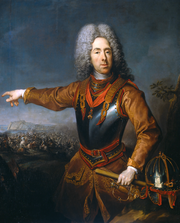
On 10 June, Marlborough met for the first time the President of the Majestic War Council, Prince Eugene – accompanied by Count Wratislaw – at the village of Mundelsheim, halfway betwixt the Danube and the Rhine.[19] By 13 June, the Imperial Field Commander, Prince Louis, had joined them in Großheppach.[20] [due east] The three generals allowable a forcefulness of nearly 110,000 men. At this conference, it was decided that Prince Eugene would return with 28,000 men to the Lines of Stollhofen on the Rhine to spotter Villeroi and Tallard and forestall them going to the assistance of the Franco-Bavarian army on the Danube. Meanwhile, Marlborough's and Prince Louis's forces would combine, totalling fourscore,000 men, and march on the Danube to seek out Maximilian II and Marsin before they could be reinforced.[21]
Knowing Marlborough's destination, Tallard and Villeroi met at Landau in the Palatinate on 13 June to construct a plan to save Bavaria. The rigidity of the French command system was such that whatever variations from the original plan had to be sanctioned by Versailles.[22] The Count of Mérode-Westerloo, commander of the Flemish troops in Tallard's ground forces, wrote "One thing is sure: we delayed our march from Alsace for far too long and quite inexplicably."[22] Blessing from King Louis arrived on 27 June: Tallard was to reinforce Marsin and Maximilian Ii on the Danube via the Black Forest, with twoscore battalions and fifty squadrons; Villeroi was to pin down the Allies defending the Lines of Stollhofen, or, if the Allies should move all their forces to the Danube, he was to join with Tallard; Coigny with 8,000 men would protect Alsace. On 1 July Tallard's army of 35,000 re-crossed the Rhine at Kehl and began its march.[22]
On 22 June, Marlborough'south forces linked up with Prince Louis' Imperial forces at Launsheim, having covered 400 km (250 mi) in v weeks.[23] [f] Thanks to a carefully planned timetable, the effects of clothing and tear had been kept to a minimum. Helm Parker described the march discipline: "As we marched through the country of our Allies, commissars were appointed to furnish us with all fashion of necessaries for man and equus caballus ... the soldiers had zip to do but pitch their tents, boil kettles and prevarication down to balance."[24] [k] In response to Marlborough'south manoeuvres, Maximilian and Marsin, conscious of their numerical disadvantage with only forty,000 men, moved their forces to the entrenched camp at Dillingen on the n bank of the Danube. Marlborough could not attack Dillingen because of a lack of siege guns – he had been unable to bring any from the Low Countries, and Prince Louis had failed to supply whatever, despite prior assurances that he would.[26]

Centrolineal set on on the Schellenberg – taken by coup de chief on two July – provided the Allies with an first-class river crossing.
The Allies needed a base for provisions and a good river crossing. Consequently, on 2 July Marlborough stormed the fortress of Schellenberg on the heights to a higher place the town of Donauwörth. Count Jean d'Arco had been sent with 12,000 men from the Franco-Bavarian military camp to hold the town and grassy hill but later on a vehement boxing, with heavy casualties on both sides, Schellenberg roughshod. This forced Donauwörth to give up shortly afterwards. Maximilian, knowing his position at Dillingen was now not tenable, took up a position behind the stiff fortifications of Augsburg.[27]
Tallard's march presented a dilemma for Prince Eugene. If the Allies were not to be outnumbered on the Danube, he realised that he had to either try to cut Tallard off before he could go at that place, or to reinforce Marlborough.[28] If he withdrew from the Rhine to the Danube, Villeroi might besides make a movement south to link up with Maximilian and Marsin. Prince Eugene compromised – leaving 12,000 troops backside guarding the Lines of Stollhofen – he marched off with the rest of his regular army to forestall Tallard.[28]
Lacking in numbers, Prince Eugene could not seriously disrupt Tallard's march only the French marshal's progress was proving slow. Tallard's strength had suffered considerably more than than Marlborough's troops on their march – many of his cavalry horses were suffering from glanders and the mountain passes were proving tough for the 2,000 wagonloads of provisions. Local German peasants, angry at French plundering, compounded Tallard's problems, leading Mérode-Westerloo to bewail – "the enraged peasantry killed several g of our men before the army was clear of the Blackness Forest."[24]
At Augsburg, Maximilian was informed on 14 July that Tallard was on his way through the Black Woods. This good news bolstered his policy of inaction, further encouraging him to expect for the reinforcements.[29] This reticence to fight induced Marlborough to undertake a controversial policy of spoliation in Bavaria, burning buildings and crops throughout the rich lands southward of the Danube. This had two aims: firstly to put pressure on Maximilian to fight or come to terms before Tallard arrived with reinforcements; and secondly, to ruin Bavaria every bit a base from which the French and Bavarian armies could attack Vienna, or pursue Marlborough into Franconia if, at some stage, he had to withdraw northwards.[30] Simply this devastation, coupled with a protracted siege of Pelting over 9 to sixteen July, caused Prince Eugene to complaining "... since the Donauwörth action I cannot admire their performances", and afterward to conclude "If he has to become home without having achieved his objective, he volition certainly be ruined."[31]
Final positioning [edit]

Tallard, with 34,000 men, reached Ulm, joining with Maximilian and Marsin at Augsburg on five August, although Maximilian had dispersed his ground forces in response to Marlborough'south entrada of ravaging the region.[32] [h] Besides on v August, Prince Eugene reached Höchstädt, riding that aforementioned dark to run across with Marlborough at Schrobenhausen. Marlborough knew that another crossing signal over the Danube was required in instance Donauwörth brutal to the enemy. So on vii Baronial, the first of Prince Louis' 15,000 Imperial troops left Marlborough's main force to besiege the heavily dedicated metropolis of Ingolstadt, 32 km (20 mi) farther downward the Danube, with the residuum following two days later.[33] [i]
With Prince Eugene'southward forces at Höchstädt on the north banking concern of the Danube, and Marlborough's at Rain on the south bank, Tallard and Maximilian debated their next motility. Tallard preferred to bide his time, furnish supplies and allow Marlborough's Danube campaign to flounder in the colder fall atmospheric condition; Maximilian and Marsin, newly reinforced, were keen to push ahead. The French and Bavarian commanders eventually agreed to attack Prince Eugene'due south smaller force. On 9 August, the Franco-Bavarian forces began to cross to the north banking concern of the Danube.[36] On 10 August, Prince Eugene sent an urgent acceleration reporting that he was falling dorsum to Donauwörth. By a series of swift marches Marlborough concentrated his forces on Donauwörth and, by noon 11 Baronial, the link-up was complete.[37]
During xi August, Tallard pushed frontwards from the river crossings at Dillingen. Past 12 Baronial, the Franco-Bavarian forces were encamped behind the small River Nebel most the village of Blenheim on the patently of Höchstädt. The same twenty-four hours, Marlborough and Prince Eugene carried out a reconnaissance of the French position from the church spire at Tapfheim, and moved their combined forces to Münster – eight kilometres (5 miles) from the French camp. A French reconnaissance under Jacques Joseph Vipart, Marquis de Silly went forward to probe the enemy, but were driven off by Allied troops who had deployed to cover the pioneers of the advancing army, labouring to span the numerous streams in the area and improve the passage leading westwards to Höchstädt.[38] [j] Marlborough quickly moved forward two brigades nether the command of Lieutenant General John Wilkes and Brigadier Archibald Rowe to secure the narrow strip of land between the Danube and the wooded Fuchsberg hill, at the Schwenningen defile.[39] Tallard's army numbered 56,000 men and 90 guns; the army of the One thousand Alliance, 52,000 men and 66 guns. Some Allied officers who were acquainted with the superior numbers of the enemy, and aware of their strong defensive position, remonstrated with Marlborough nigh the hazards of attacking; but he was resolute.[39]
Battle [edit]
The battlefield [edit]
The battlefield stretched for most 6 km (three+ 1⁄2 mi). The extreme right flank of the Franco-Bavarian army rested on the Danube, the undulating pine-covered hills of the Swabian Jura lay to their left. A small stream, the Nebel, fronted the French line; the ground either side of this was marshy and just fordable intermittently. The French right rested on the village of Blenheim near where the Nebel flows into the Danube; the village itself was surrounded by hedges, fences, enclosed gardens, and meadows. Between Blenheim and the hamlet of Oberglauheim to the due north due west the fields of wheat had been cutting to stubble and were now platonic for the deployment of troops. From Oberglauheim to the next hamlet of Lutzingen the terrain of ditches, thickets and brambles was potentially difficult footing for the attackers.[40]
Initial manoeuvres [edit]

The position of the forces at apex, thirteen Baronial. Marlborough took control of the left arm of the Centrolineal forces including the attacks on Blenheim and Oberglauheim, whilst Prince Eugene commanded the correct including the attacks on Lutzingen.
At 02:00 on 13 Baronial, xl Allied cavalry squadrons were sent forward, followed at 03:00, in eight columns, by the main Allied forcefulness pushing over the River Kessel. At most 06:00 they reached Schwenningen, three kilometres (2 miles) from Blenheim. The British and German troops who had held Schwenningen through the nighttime joined the march, making a ninth column on the left of the regular army. Marlborough and Prince Eugene made their final plans. The Allied commanders agreed that Marlborough would command 36,000 troops and attack Tallard'southward strength of 33,000 on the left, including capturing the village of Blenheim, while Prince Eugene's 16,000 men would attack Maximilian and Marsin'south combined forces of 23,000 troops on the correct. If this assault was pressed hard, it was anticipated that Maximilian and Marsin would feel unable to send troops to help Tallard on their right.[41] Lieutenant-General John Cutts would set on Blenheim in concert with Prince Eugene'southward assail. With the French flanks busy, Marlborough could cross the Nebel and evangelize the fatal blow to the French at their centre.[42] The Allies would have to look until Prince Eugene was in position before the general engagement could begin.[43]
Tallard was not anticipating an Allied attack; he had been deceived by intelligence gathered from prisoners taken by de Silly the previous twenty-four hour period, and his army'due south strong position. Tallard and his colleagues believed that Marlborough and Prince Eugene were about to retreat north-westwards towards Nördlingen.[44] [k] Tallard wrote a report to this effect to King Louis that morning.[46] Point guns were fired to bring in the foraging parties and pickets as the French and Bavarian troops drew into battle-social club to face up the unexpected threat.[47]
Well-nigh 08:00 the French arms on their right wing opened fire, answered by Colonel Holcroft Claret's batteries.[l] The guns were heard by Prince Louis in his campsite before Ingolstadt.[49] An hour later Tallard, Maximilian, and Marsin climbed Blenheim's church building tower to finalise their plans. It was settled that Maximilian and Marsin would hold the front end from the hills to Oberglauheim, whilst Tallard would defend the ground betwixt Oberglauheim and the Danube. The French commanders were divided every bit to how to utilize the Nebel. Tallard's preferred tactic was to lure the Allies across before unleashing his cavalry upon them. This was opposed by Marsin and Maximilian who felt it better to shut their infantry right up to the stream itself, so that while the enemy was struggling in the marshes, they would be caught in crossfire from Blenheim and Oberglauheim. Tallard'due south arroyo was sound if all its parts were implemented, but in the event it allowed Marlborough to cross the Nebel without serious interference and fight the battle he had planned.[fifty]
Deployment [edit]

The Franco-Bavarian commanders deployed their forces. In the hamlet of Lutzingen, Count Alessandro de Maffei positioned five Bavarian battalions with a great battery of 16 guns at the village'south edge. In the woods to the left of Lutzingen, seven French battalions under César Armand, Marquis de Rozel moved into place. Between Lutzingen and Oberglauheim Maximilian placed 27 squadrons of cavalry and xiv Bavarian squadrons allowable by d'Arco with 13 more in support nearby nether Baron Veit Heinrich Moritz Freiherr von Wolframsdorf. To their right stood Marsin's 40 French squadrons and 12 battalions. The village of Oberglauheim was packed with 14 battalions allowable by Jean-Jules-Armand Colbert, Marquis de Blainville, including the effective Irish Brigade known as the "Wild Geese". Six batteries of guns were ranged aslope the village.[51] On the right of these French and Bavarian positions, between Oberglauheim and Blenheim, Tallard deployed 64 French and Walloon squadrons, 16 of which were from Marsin, supported past nine French battalions continuing nigh the Höchstädt route. In the cornfield next to Blenheim stood three battalions from the Regiment de Roi. Nine battalions occupied the village itself, commanded past Philippe, Marquis de Clérambault. Four battalions stood to the rear and a farther eleven were in reserve. These battalions were supported by Count Gabriel d'Hautefeuille's twelve squadrons of dismounted dragoons.[51] Past 11:00 Tallard, Maximilian, and Marsin were in place. Many of the Allied generals were hesitant to attack such a stiff position. The Earl of Orkney afterwards said that, "had I been asked to requite my opinion, I had been against it."[52]
Prince Eugene was expected to exist in position by xi:00, but due to the difficult terrain and enemy burn down, progress was slow.[53] Cutts' column – which by 10:00 had expelled the enemy from ii water mills on the Nebel – had already deployed by the river against Blenheim, enduring over the next three hours severe fire from a 6-gun heavy battery posted nigh the village. The rest of Marlborough's army, waiting in their ranks on the forward slope, were also forced to bear the cannonade from the French arms, suffering 2,000 casualties before the assault could fifty-fifty start.[54] Meanwhile, engineers repaired a stone bridge across the Nebel, and constructed 5 boosted bridges or causeways across the marsh between Blenheim and Oberglauheim. Marlborough's feet was finally allayed when, just past noon, Colonel William Cadogan reported that Prince Eugene's Prussian and Danish infantry were in identify – the order for the general accelerate was given. At 13:00, Cutts was ordered to attack the hamlet of Blenheim whilst Prince Eugene was requested to assault Lutzingen on the Allied right flank.[55]
Blenheim [edit]

Part of the Battle of Blenheim tapestry at Blenheim Palace past Judocus de Vos. In the background is the village of Blenheim; in the middle ground are the 2 water mills that Rowe had to take to gain a bridgehead over the Nebel. The foreground shows an English grenadier with a captured French color.
Cutts ordered Rowe's brigade to attack. The English infantry rose from the border of the Nebel, and silently marched towards Blenheim, a distance of some 150 m (160 yd). James Ferguson'southward Scottish brigade supported Rowe's left, and moved towards the barricades betwixt the hamlet and the river, defended by Hautefeuille's dragoons. As the range airtight to within xxx one thousand (30 yd), the French fired a deadly volley. Rowe had ordered that there should be no firing from his men until he struck his sword upon the palisades, but every bit he stepped forward to give the signal, he fell mortally wounded.[56] [yard] The survivors of the leading companies airtight up the gaps in their ranks and rushed forward. Small parties penetrated the defences, but repeated French volleys forced the English dorsum and inflicted heavy casualties. As the assault faltered, eight squadrons of aristocracy Gens d'Armes, commanded by the veteran Swiss officer, Béat Jacques II de Zurlauben, cruel on the English troops, cutting at the exposed flank of Rowe's ain regiment.[n] Wilkes' Hessian brigade, nearby in the marshy grass at the water's border, stood firm and repulsed the Gens d'Armes with steady fire, enabling the English and Hessians to re-lodge and launch another attack.[58]
Although the Allies were once again repulsed, these persistent attacks on Blenheim somewhen bore fruit, panicking Clérambault into making the worst French error of the day.[59] Without consulting Tallard, Clérambault ordered his reserve battalions into the village, upsetting the balance of the French position and nullifying the French numerical superiority. "The men were then crowded in upon one some other", wrote Mérode-Westerloo, "that they couldn't even fire – allow alone receive or conduct out whatsoever orders".[59] Marlborough, spotting this fault, now countermanded Cutts' intention to launch a tertiary assault, and ordered him simply to contain the enemy within Blenheim; no more than 5,000 Allied soldiers were able to pen in twice the number of French infantry and dragoons.[60]
Lutzingen [edit]
... Prince Eugene and the Purple troops had been repulsed three times – driven right back to the woods – and had taken a real drubbing. – Mérode-Westerloo.[61]

Memorial for the Battle of Blenheim 1704, Lutzingen, Germany
On the Allied right, Prince Eugene's Prussian and Danish forces were desperately fighting the numerically superior forces of Maximilian and Marsin. Leopold I, Prince of Anhalt-Dessau led forward four brigades across the Nebel to assault the well-fortified position of Lutzingen. Here, the Nebel was less of an obstruction, simply the great bombardment positioned on the edge of the village enjoyed a practiced field of burn down beyond the open footing stretching to the hamlet of Schwennenbach. As soon every bit the infantry crossed the stream, they were struck past Maffei's infantry, and salvoes from the Bavarian guns positioned both in forepart of the village and in enfilade on the wood-line to the right. Despite heavy casualties the Prussians attempted to storm the nifty battery, whilst the Danes, nether Count Jobst von Scholten, attempted to bulldoze the French infantry out of the copses beyond the village.[62]
With the infantry heavily engaged, Prince Eugene'southward cavalry picked its way across the Nebel. Later an initial success, his starting time line of cavalry, nether the Imperial General of Horse, Prince Maximilian of Hanover, were pressed by the second line of Marsin's cavalry and forced dorsum across the Nebel in confusion. The exhausted French were unable to follow up their advantage, and both cavalry forces tried to regroup and reorder their ranks.[63] Without cavalry support, and threatened with envelopment, the Prussian and Danish infantry were in turn forced to pull back beyond the Nebel. Panic gripped some of Prince Eugene's troops as they crossed the stream. Ten infantry colours were lost to the Bavarians, and hundreds of prisoners taken; it was but through the leadership of Prince Eugene and the Prince Maximilian of Hanover that the Imperial infantry was prevented from abandoning the field.[64]
Subsequently rallying his troops nearly Schwennenbach – well beyond their starting point – Prince Eugene prepared to launch a second assail, led by the second-line squadrons under the Knuckles of Württemberg-Teck. Still once more they were caught in the murderous crossfire from the arms in Lutzingen and Oberglauheim, and were once once more thrown back in disarray. The French and Bavarians were almost as disordered as their opponents, and they too were in demand of inspiration from their commander, Maximilian, who was seen " ... riding up and down, and inspiring his men with fresh courage."[65] Anhalt-Dessau's Danish and Prussian infantry attacked a 2nd time but could non sustain the advance without proper back up. Again they fell back beyond the stream.[66]
Centre and Oberglauheim [edit]

The Battle of Blenheim by Joshua Ross
Whilst these events around Blenheim and Lutzingen were taking place, Marlborough was preparing to cross the Nebel. Hulsen'due south brigade of Hessians and Hanoverians and the earl of Orkney's British brigade avant-garde across the stream and were supported by dismounted British dragoons and ten British cavalry squadrons. This roofing force allowed Charles Churchill's Dutch, British and High german infantry and further cavalry units to advance and class up on the plain beyond. Marlborough arranged his infantry battalions in a novel manner with gaps sufficient to allow the cavalry to move freely betwixt them.[67] Marlborough ordered the germination forrad. Once again Zurlauben's Gens d'Armes charged, looking to rout Henry Lumley's English cavalry who linked Cutts' column facing Blenheim with Churchill's infantry. Every bit the elite French cavalry attacked, they were faced by 5 English squadrons under Colonel Francis Palmes. To the consternation of the French, the Gens d'Armes were pushed back in defoliation and pursued well beyond the Maulweyer stream that flows through Blenheim.[68] "What? Is it possible?" exclaimed Maximilian, "the gentlemen of French republic fleeing?"[69] Palmes attempted to follow up his success but was repulsed by other French cavalry and musket fire from the border of Blenheim.[68]
Nevertheless, Tallard was alarmed by the repulse of the Gens d'Armes and urgently rode across the field to ask Marsin for reinforcements; merely on the basis of being hard pressed past Prince Eugene – whose second attack was in total inundation – Marsin refused.[70] Equally Tallard consulted with Marsin, more of his infantry were taken into Blenheim by Clérambault. Fatally, Tallard, although enlightened of the situation, did nothing to rectify it, leaving him with only the nine battalions of infantry nigh the Höchstädt road to oppose the massed enemy ranks in the centre.[70] Zurlauben tried several more times to disrupt the Allies forming on Tallard's side of the stream. His front-line cavalry darted forrad downwardly the gentle slope towards the Nebel, only the attacks lacked co-ordination, and the Allied infantry's steady volleys disconcerted the French horsemen.[71] During these skirmishes Zurlauben brutal mortally wounded; he died 2 days later. At this phase the time was just after fifteen:00.[72]
The Danish cavalry, under Carl Rudolf, Duke of Württemberg-Neuenstadt, had made slow work of crossing the Nebel near Oberglauheim. Harassed past Marsin's infantry near the hamlet, the Danes were driven back across the stream. Count Horn'south Dutch infantry managed to push the French back from the h2o's edge, but it was apparent that before Marlborough could launch his main effort confronting Tallard, Oberglauheim would have to be secured.[73]
Count Horn directed Anton Günther, Fürst von Holstein-Beck to take the village, but his two Dutch brigades were cutting downward by the French and Irish troops, capturing and badly wounding Holstein-Brook during the action.[74] The battle was now in the balance. If Holstein-Brook's Dutch column were destroyed, the Allied army would be separate in ii: Prince Eugene's wing would be isolated from Marlborough's, passing the initiative to the Franco-Bavarian forces.[75] [o] Seeing the opportunity, Marsin ordered his cavalry to modify from facing Prince Eugene, and turn towards their right and the open flank of Churchill's infantry drawn up in front of Unterglau.[73] Marlborough, who had crossed the Nebel on a makeshift bridge to have personal control, ordered Hulsen's Hanoverian battalions to support the Dutch infantry. A nine-gun artillery bombardment and a Dutch cavalry brigade under Averock were as well chosen forward, merely the cavalry soon came nether pressure from Marsin's more numerous squadrons.[76]
Marlborough now requested Prince Eugene to release Count Hendrick Fugger and his Royal Cuirassier brigade to assist repel the French cavalry thrust. Despite his own difficulties, Prince Eugene at in one case complied.[77] Although the Nebel stream lay between Fugger'due south and Marsin's squadrons, the French were forced to change front to meet this new threat, thus preventing Marsin from striking at Marlborough's infantry.[78] Fugger'due south cuirassiers charged and, striking at a favourable bending, threw back Marsin's squadrons in disorder.[79] With support from Blood'due south batteries, the Hessian, Hanoverian and Dutch infantry – now commanded by Count Berensdorf – succeeded in pushing the French and Irish infantry dorsum into Oberglauheim and then that they could non again threaten Churchill'south flank as he moved confronting Tallard. The French commander in the village, de Blainville, was numbered among the heavy casualties.[47]
Breakthrough [edit]
The [French] foot remained in the best club I always saw, till they were cutting to pieces almost in rank and file. – Lord Orkney.[eighty]
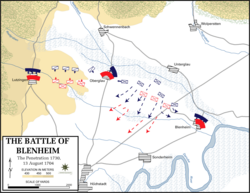
Quantum: Position of the battle at 17:30.
Past 16:00, with large parts of the Franco-Bavarian army besieged in Blenheim and Oberglau, the Allied eye of 81 squadrons (nine squadrons had been transferred from Cutts' cavalcade) supported past 18 battalions was firmly planted amidst the French line of 64 squadrons and nine battalions of raw recruits. At that place was now a break in the boxing: Marlborough wanted to assail simultaneously along the whole front, and Prince Eugene, after his second repulse, needed time to reorganise.[81]
By just after 17:00 all was fix along the Allied front. Marlborough's two lines of cavalry had now moved to the front of his line of battle, with the ii supporting lines of infantry behind them. Mérode-Westerloo attempted to extricate some French infantry crowded into Blenheim, but Clérambault ordered the troops back into the village. The French cavalry exerted themselves once more confronting the Centrolineal commencement line – Lumley's English language and Scots on the Allied left, and Reinhard Vincent Graf von Hompesch's Dutch and German squadrons on the Centrolineal right. Tallard's squadrons, which lacked infantry back up and were tired, managed to push the Allied first line back to their infantry support. With the battle even so not won, Marlborough had to rebuke one of his cavalry officers who was attempting to leave the field – "Sir, you are nether a mistake, the enemy lies that way ..."[lxxx] Marlborough commanded the second Allied line, nether Cuno Josua von Bülow and Friedrich Johann von Bothmer, to movement forward, and, driving through the centre, the Allies finally routed Tallard's tired cavalry. The Prussian Life Dragoons' Colonel, Ludwig von Blumenthal, and his second in command, Lieutenant Colonel von Hacke, vicious next to each other, but the charge succeeded. With their cavalry in headlong flying, the remaining nine French infantry battalions fought with desperate valour, trying to form a square,[80] merely they were overwhelmed by Blood's close-range artillery and platoon fire. Mérode-Westerloo after wrote – "[They] died to a homo where they stood, stationed right out in the open up plain – supported by nobody."[fourscore]
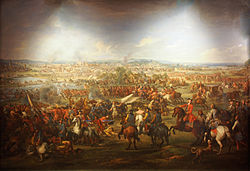
The majority of Tallard's retreating troops headed for Höchstädt but well-nigh did non brand the condom of the town, plunging instead into the Danube where over 3,000 French horsemen drowned;[p] others were cutting down by the pursuing Allied cavalry. The Marquis de Gruignan attempted a counter-assault, but he was brushed aside by the triumphant Allies. Subsequently a final rally behind his campsite'due south tents, shouting entreaties to stand and fight, Tallard was caught upwardly in the rout and swept towards Sonderheim.[83] Surrounded by a squadron of Hessian troops, Tallard surrendered to Lieutenant Colonel de Boinenburg, the Prince of Hesse-Kassel's adjutant-de-camp, and was sent under escort to Marlborough.[84] Marlborough welcomed the French commander – "I am very distressing that such a cruel misfortune should accept fallen upon a soldier for whom I have the highest regard."[83]
Meanwhile, the Allies had once again attacked the Bavarian stronghold at Lutzingen. Prince Eugene became exasperated with the performance of his Royal cavalry whose tertiary attack had failed: he had already shot two of his troopers to prevent a general flight. Then, declaring in disgust that he wished to "fight among brave men and non among cowards", Prince Eugene went into the attack with the Prussian and Danish infantry, every bit did Leopold I, waving a regimental colour to inspire his troops.[85] This time the Prussians were able to storm the swell Bavarian battery, and overwhelm the guns' crews.[86] Beyond the village, Scholten's Danes defeated the French infantry in a desperate manus-to-hand bayonet struggle.[q] When they saw that the centre had broken, Maximilian and Marsin decided the battle was lost; like the remnants of Tallard'south army, they fled the battlefield, albeit in better order than Tallard's men.[88] Attempts to organise an Allied force to forestall Marsin's withdrawal failed attributable to the burnout of the cavalry, and the growing confusion in the field.[89]
Fall of Blenheim [edit]
... our men fought in and through the fire ... until many on both sides were burned to death. – Private Deane, 1st Regiment Foot Guards.[90]

Marlborough now turned his attention from the fleeing enemy to directly Churchill to detach more infantry to storm Blenheim. Orkney's infantry, Hamilton's English language brigade and St Paul'southward Hanoverians moved across the trampled wheat to the cottages. Vehement hand-to-manus fighting gradually forced the French towards the hamlet centre, in and effectually the walled churchyard which had been prepared for defense force. Lord John Hay and Charles Ross's dismounted dragoons were also sent, but suffered under a counter-charge delivered past the regiments of Artois and Provence under command of Colonel de la Silvière. Colonel Belville'due south Hanoverians were fed into the battle to steady the resolve of the dragoons, who attacked again. The Centrolineal progress was ho-hum and hard, and like the defenders, they suffered many casualties.[91]
Many of the cottages were now burning, obscuring the field of fire and driving the defenders out of their positions. Hearing the din of battle in Blenheim, Tallard sent a bulletin to Marlborough offering to club the garrison to withdraw from the field. "Inform Monsieur Tallard", replied Marlborough, "that, in the position in which he is at present, he has no command."[92] Nevertheless, as dusk came the Allied commander was anxious for a quick conclusion. The French infantry fought tenaciously to agree on to their position in Blenheim, but their commander was nowhere to be found.[93] By at present Blenheim was under set on from every side by three British generals: Cutts, Churchill, and Orkney. The French had repulsed every assail, merely many had seen what had happened on the plain: their regular army was routed and they were cut off.[94] Orkney, attacking from the rear, now tried a unlike tactic – "... it came into my head to crush parley", he later wrote, "which they accepted of and immediately their Brigadier de Nouville capitulated with me to be prisoner at discretion and lay downward their arms." Threatened by Allied guns, other units followed their example. It was not until 21:00 that the Marquis de Blanzac, who had taken charge in Clérambault'south absence, reluctantly accustomed the inevitability of defeat, and some 10,000 of France'due south best infantry had laid downward their arms.[95]
During these events Marlborough was withal in the saddle organising the pursuit of the broken enemy. Pausing for a moment he scribbled on the back of an old tavern bill a notation addressed to his wife, Sarah: "I have no time to say more just to beg you volition give my duty to the Queen, and let her know her army has had a glorious victory."[96] [r]
Aftermath [edit]

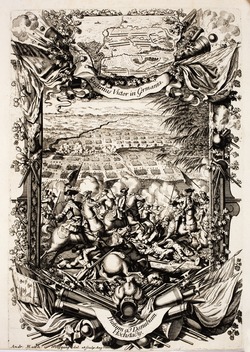
Battle of Höchstädt by Wolfgang and Vind
French losses were immense, with over 27,000 killed, wounded and captured.[97] [98] Moreover, the myth of French invincibility had been destroyed and King Louis'due south hopes of an early and victorious peace were over.[98] Mérode-Westerloo summarised the example confronting Tallard's army:
The French lost this battle for a wide variety of reasons. For one affair they had too good an stance of their own power ... Some other point was their faulty field dispositions, and in add-on there was rampant indiscipline and inexperience displayed ... It took all these faults to lose so celebrated a battle.[99]
It was a difficult-fought contest, leading Prince Eugene to observe – "I accept not a squadron or battalion which did not charge four times at least."[100]
Although the war dragged on for years, the Battle of Blenheim was probably its most decisive victory; Marlborough and Prince Eugene had saved the Habsburg Empire and thereby preserved the K Alliance from collapse.[101] [ane] Munich, Augsburg, Ingolstadt, Ulm and the remaining territory of Bavaria soon fell to the Allies. By the Treaty of Ilbersheim, signed on seven November, Bavaria was placed nether Austrian military rule, assuasive the Habsburgs to use its resource for the residuum of the disharmonize.[102]
The remnants of Maximilian and Marsin's wing limped back to Strasbourg, losing another 7,000 men through desertion.[99] Despite being offered the risk to remain as ruler of Bavaria, under the strict terms of an alliance with Austria, Maximilian left his state and family in social club to proceed the war against the Allies from the Spanish Netherlands where he still held the post of governor-general. Tallard – who, dissimilar his subordinates, was non ransomed or exchanged – was taken to England and imprisoned in Nottingham until his release in 1711.[103]
The 1704 campaign lasted longer than usual, for the Allies sought to extract the maximum advantage. Realising that France was too powerful to be forced to brand peace past a single victory, Prince Eugene, Marlborough and Prince Louis met to plan their side by side moves. For the following yr Marlborough proposed a entrada forth the valley of the Moselle to carry the war deep into France. This required the capture of the major fortress of Landau which guarded the Rhine, and the towns of Trier and Trarbach on the Moselle itself.[103] Trier was taken on 27 October and Landau fell on 23 November to Prince Louis and Prince Eugene; with the fall of Trarbach on 20 December, the campaign season for 1704 came to an end. The planned offensive never materialised as the G Alliance'southward regular army had to depart the Moselle to defend Liège from a French counteroffensive.[104] The war raged on for another decade.[i]
Marlborough returned to England on xiv Dec (O.S) to the acclamation of Queen Anne and the state. In the first days of Jan, the 110 cavalry standards and 128 infantry colours that had been captured during the battle were borne in procession to Westminster Hall.[s] In Feb 1705, Queen Anne, who had fabricated Marlborough a knuckles in 1702, granted him the Park of Woodstock and promised a sum of £240,000 to build a suitable house equally a souvenir from a grateful Crown in recognition of his victory; this resulted in the structure of Blenheim Palace. The British historian Sir Edward Shepherd Creasy considered Blenheim one of the pivotal battles in history, writing: "Had information technology not been for Blenheim, all Europe might at this day suffer under the effect of French conquests resembling those of Alexander in extent and those of the Romans in durability."[106] The military historian John A. Lynn considers this claim unjustified, for Male monarch Louis never had such an objective; the entrada in Bavaria was intended only to bring a favourable peace settlement and not domination over Europe.[i]
Lake poet Robert Southey criticised the Battle of Blenheim in his anti-war poem "Afterwards Blenheim", but afterwards praised the victory every bit "the greatest victory which had ever done honour to British arms".[107]
Notes [edit]
- ^ The village of Blindheim (Blenheim in English) lies on the Danube River, 16 km (x mi) southwest of Donauwörth in Bavaria, southern Germany.
- ^ The initial strength of 21,000 men were accompanied by 1,700 supply carts drawn by v,000 draught horses. The artillery needed as many more.[ten]
- ^ Barnett and Coxe states 45 squadrons and 36 battalions.
- ^ Chandler p. 131 states that many men were lost on the return journey through desertion.
- ^ Prince Eugene had doubts virtually Prince Louis's reliability, for he was a close friend of Maximilian. It was fifty-fifty suspected that Prince Louis was secretly respective with his erstwhile comrade.[20]
- ^ Lynn (2013, p. 290) states that the march-rate was not unprecedented for the menstruum, averaging 12 km (7+ 1⁄2 mi) per day. What stands out was the total altitude covered and the fine status of the troops when they arrived.
- ^ The Centrolineal march was not without loss, some 900 men were lost to desertion or sickness, though this figure was depression considering the length and step of the march over bad roads and in poor atmospheric condition and many of the ill afterwards rejoined the army.[25]
- ^ Lynn (2013, p. 290) states Tallard reached Augsburg on 3 August.
- ^ Modern historians including Falkner, Holmes and David consider this may accept been a device to get the "cautious and obstructive Margrave [Prince Louis of Baden] out of the way". In a letter of the alphabet of 31 July 1704 Marlborough assured the Dutch statesman Anthonie Heinsius that the determination to commence a siege was sound.[34] [33] [35]
- ^ The French had captured four prisoners. Nether examination they declared that the whole Allied army was going to motility off towards Nördlingen the next morning.[38]
- ^ Several sources[45] suggest that Marlborough had planted this corroborative 'evidence' for Tallard.
- ^ Churchill states 08:thirty.[48]
- ^ Ii of Rowe'due south staff officers were killed trying to carry him away: Lieutenant Colonel Dalyell and Major Campbell.[56]
- ^ Churchill[57] and Coxe state but three squadrons of Gens d'Armes. Rowe's ain regiment lost their colours, but they were soon retrieved past the Hessians.
- ^ Tallard afterward recorded – "At this moment I saw the promise of victory."[75]
- ^ Churchill states[82] that it was the "greater part" of 2,000 men who drowned
- ^ Danish infantry suffered 2,401 casualties (including ane,350 killed) fighting for possession of the woods across Lutzingen [87]
- ^ The bulletin was carried to London past Colonel Daniel Parke.[96]
- ^ Churchill states 171 standards and 129 colours.[105]
References [edit]
- ^ a b c d Lynn 2013, p. 294.
- ^ a b Chandler 2003, p. 124.
- ^ Lynn 2013, p. 285.
- ^ Chandler 2003, p. 125.
- ^ Tucker 2009, pp. 693–94.
- ^ Tucker 2015, p. 200.
- ^ a b Chandler 2003, p. 127.
- ^ Churchill 1934, p. 324.
- ^ Chandler 2003, p. 128.
- ^ Phelan 1990, p. 36.
- ^ Falkner 2004, p. 19.
- ^ a b Chandler 2003, p. 129.
- ^ Webb 2013, p. 59.
- ^ a b Falkner 2004, p. 20.
- ^ Tincey 2004, p. 31.
- ^ Falkner 2004, p. 22.
- ^ Barnett 1999, p. 89.
- ^ a b Barnett 1999, p. 91.
- ^ Falkner 2004, p. 23.
- ^ a b Falkner 2004, p. 25.
- ^ Chandler 2003, p. 132.
- ^ a b c Chandler 2003, p. 133.
- ^ Lynn 2013, p. 287.
- ^ a b Chandler 2003, p. 131.
- ^ Falkner 2014, p. 52.
- ^ Falkner 2004, p. 26.
- ^ Falkner 2004, p. 40.
- ^ a b Henderson 1966, p. 103.
- ^ Chandler 2003, p. 139.
- ^ Falkner 2004, p. 41.
- ^ Spencer 2005, p. 215.
- ^ Falkner 2004, p. 44.
- ^ a b Holmes 2008, p. 279.
- ^ Falkner 2014, p. 66.
- ^ David 2012, p. 103.
- ^ Falkner 2004, p. 47.
- ^ Chandler 2003, p. 141.
- ^ a b Churchill 2002, p. 842.
- ^ a b Coxe 1847, p. 188.
- ^ Barnett 1999, p. 106.
- ^ Falkner 2004, p. 57.
- ^ Caddick-Adams 2001, pp. 133–35.
- ^ Chandler 1964, p. 37.
- ^ Barnett 1999, p. 108.
- ^ Churchill 1934, p. 433.
- ^ Barnett 1999, p. 109.
- ^ a b Falkner 2004, p. 82.
- ^ Churchill 1934, p. 438.
- ^ Churchill 2002, p. 848.
- ^ Falkner 2004, p. 58.
- ^ a b Falkner 2004, p. 61.
- ^ Falkner 2004, p. 62.
- ^ Falkner 2004, p. 63.
- ^ Churchill 2002, p. 852.
- ^ Falkner 2004, p. 66.
- ^ a b Churchill 2002, p. 853.
- ^ Churchill 1934, p. 445.
- ^ Falkner 2004, p. 68.
- ^ a b Chandler 1998, p. 145.
- ^ Falkner 2004, p. seventy.
- ^ Spencer 2005, p. 270.
- ^ Falkner 2004, p. 71.
- ^ Tincey 2004, p. 67.
- ^ Spencer 2005, p. 268.
- ^ Falkner 2004, p. 73.
- ^ Falkner 2008, pp. 49–50.
- ^ Falkner 2008, p. 50.
- ^ a b Falkner 2004, p. 76.
- ^ Churchill 2002, p. 856.
- ^ a b Falkner 2004, p. 77.
- ^ Falkner 2004, p. 78.
- ^ Falkner 2004, p. 117.
- ^ a b Falkner 2008, p. 53.
- ^ Spencer 2005, p. 264.
- ^ a b Falkner 2004, p. fourscore.
- ^ Falkner 2008, p. 54.
- ^ Chandler 1998, p. 161.
- ^ Falkner 2004, p. 81.
- ^ Churchill 2002, p. 858.
- ^ a b c d Falkner 2004, p. 86.
- ^ Churchill 2002, p. 860.
- ^ Churchill 1934, p. 456.
- ^ a b Falkner 2004, p. 90.
- ^ Tincey 2004, p. 85.
- ^ McKay 1977, p. 86.
- ^ Falkner 2004, p. 91.
- ^ Falkner 2008, p. 58.
- ^ Falkner 2008, pp. 62–63.
- ^ Falkner 2008, p. 63.
- ^ Spencer 2005, p. 294.
- ^ Falkner 2004, p. 95.
- ^ Churchill 2002, p. 865.
- ^ Spencer 2005, p. 291.
- ^ Churchill 2002, p. 867.
- ^ Falkner 2004, p. 98.
- ^ a b Barnett 1999, p. 121.
- ^ Clodfelter 2017, p. 185.
- ^ a b Barnett 1999, p. 122.
- ^ a b Chandler 2003, p. 149.
- ^ Falkner 2004, p. 103.
- ^ McKay 1977, p. 88.
- ^ Lynn 2013, p. 293.
- ^ a b Tincey 2004, p. 88.
- ^ Weigley 2004, p. 87.
- ^ Churchill 1934, p. 466.
- ^ Creasy 1851, p. 154.
- ^ Speck 2006, pp. 79–fourscore.
Sources [edit]
- Barnett, Correlli (1999). Marlborough. Wordsworth Editions Limited. ISBN978-1-84022-200-5.
- Caddick-Adams, Peter (2001). "Blenheim, battle and campaign of". In Holmes, Richard (ed.). The Oxford Companion to Armed forces History. Oxford: Oxford University Press. ISBN0-19-866209-two.
- Chandler, David G. (1998). A Guide to the Battlefields of Europe. Wordsworth Editions Express. ISBN978-i-85326-694-2.
- Chandler, David G. (2003). Marlborough as Military Commander. Spellmount Ltd. ISBN978-1-86227-195-ane.
- Chandler, David (1964). "Blenheim, 1704". In Falls, Cyril (ed.). Great Military Battles. New York City: MacMillan. pp. 30–41. OCLC 221501112.
- Clodfelter, M. (2017). Warfare and Armed Conflicts: A Statistical Encyclopedia of Casualty and Other Figures, 1492–2015 (4th ed.). Jefferson, NC: McFarland. ISBN978-0-7864-7470-seven.
- Churchill, Winston (1934). Marlborough: His Life and Times. Vol. II. London: George G Harrap.
- Churchill, Winston (2002). Marlborough: His Life and Times. Vol. Bk. 1, vol. ii. University of Chicago Press. ISBN978-0-226-10633-five.
- Coxe, William (1847). Memoirs of the Duke of Marlborough. Vol. i. London.
- Creasy, Edward Shepherd (1851). The Fifteen Decisive Battles of the Earth. Vol. II. London: Richard Bentley.
- David, Saul (2012). All the Rex's Men: The British Soldier from the Restoration to Waterloo. London: Viking. ISBN978-0-670-91663-4.
- Falkner, James (2004). Battle Story: Blenheim 1704. Pen & Sword. ISBN0752499688.
- Falkner, James (2008). Marlborough's Battlefields. Barnsley, U.k.: Pen and Sword. ISBN978-1-84415-632-0.
- Falkner, James (2014). Blenheim 1704: Marlborough's Greatest Victory. Spellmount. ISBN978-1-84415-050-2.
- Henderson, Nicholas (1966). Prince Eugen of Savoy. Weidenfeld & Nicolson. ISBN978-ane-84212-597-7.
- Holmes, Richard (2008). Marlborough: England's Fragile Genius. HarperCollins. ISBN978-0-00-722571-2.
- Lynn, John A. (2013). The Wars of Louis 14 1667–1714. Routledge. ISBN978-1-317-89951-eight.
- McKay, Derek (1977). Prince Eugene of Savoy. Thames & Hudson. ISBN978-0-500-87007-5.
- Phelan, Ivan P. (1990). "Marlborough every bit Logistician (Connected)". Periodical of the Club for Army Historical Research. 68 (273): 36–48. ISSN 0037-9700. JSTOR 44224692.
- Speck, William Arthur (2006). Robert Southey: Entire Homo of Letters. New Oasis, CT: Yale University Press. ISBN0-300-11681-0.
- Spencer, Charles (2005). Blenheim: Battle for Europe. Phoenix. ISBN978-0-304-36704-7.
- Tincey, John (2004). Blenheim 1704: The Duke of Marlborough'due south Masterpiece. Osprey Publishing Ltd. ISBN978-1-84176-771-0.
- Tucker, Spencer C., ed. (2009). A Global Chronology of Disharmonize: From the Aboriginal Earth to the Modern Middle Eastward. Vol. two. ABC-CLIO.
- Tucker, Spencer C. (2015). Wars That Changed History: fifty of the World's Greatest Conflicts. ABC-CLIO. ISBN978-1-61069-786-6.
- Webb, Stephen Saunders (2013). Marlborough'due south America. New York: Yale University Press. ISBN978-0-300-17859-iii.
- Weigley, Russell F. (2004). The Age of Battles: The Quest for Decisive Warfare from Breitenfeld to Waterloo. Indiana University Press. ISBN978-0-253-21707-3.
External links [edit]
-
 Texts on Wikisource:
 - Marlborough's notation to his wife Sarah at the stop of the Battle of Blenheim
- The Battle of Blenheim, a poem past Robert Southey
- The Fifteen Decisive Battles of the World § Chapter Xi. The Battle of Blenheim, 1704
- Text on the Column of Victory in the grounds of Blenheim Palace
Source: https://en.wikipedia.org/wiki/Battle_of_Blenheim
0 Response to "I Promised That Is Act of Indiscipline Did Not Occurred Again"
Post a Comment