Nothing Will Come of Nothing Speak Again
Male monarch Lear
Act Ane, Office One
Past Dennis Abrams
———————–
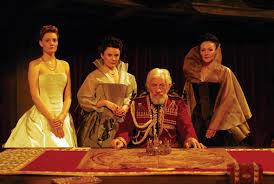 MAJOR CHARACTERS
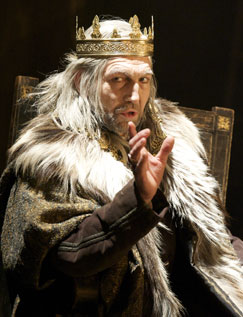
King Lear of Britain
Goneril, Lear's oldest daughter
Duke of Albany, Goneril's married man
Regan, Lear's second daughter
Duke of Cornwall, Regan's husband
Cordelia, Lear's youngest daughter
Duke of Burgundy, Cordelia's first suitor
King of French republic, Cordelia's second suitor
Earl of Kent, a follower of Lear (later disguised as Caius, a servant of the Rex)
Earl of Gloucester
Edgar, Gloucester's legitimate son, and his eldest (later disguised equally "Poor Tom")
Edmund, Gloucester's illegitimate and younger son
Quondam Homo, a retainer of Gloucester
Curan, a courtier
Fool in Lear's service
Oswald, Goneril's steward
——————————————————
 Act Ane: King Lear wishes to divide his kingdom amid his 3 daughters, according to whoever loves him most. Goneril and Regan speak sycophantically (buss his donkey to put it bluntly) and are rewarded, but his younger (and favorite) daughter Cordelia refuses to flatter him. Angered by her response, Lear rejects her and gives her share to her sisters – with whom he now intends to spend his fourth dimension now that he'due south "retired." Despite Cordelia's loss of royal favor, the King of France agrees to marry her, but when Kent tries to defend her, Lear banishes him. Meanwhile, Gloucester'south illegitimate son Edmund is planning to frame his brother Edgar and steal his land; he shows Gloucester a forged alphabetic character supposedly revealing Edgar's plans to impale him. At Goneril's castle, the new domestic arrangements, are, not surprisingly, non working: Lear and what remains of his retinue are defendant of being too rowdy, then he departs in a rage for Regan's palace, forth with the Fool and a disguised Kent.
——
If you look at information technology one way, King Lear is all almost politics. Information technology begins with a ruler's coincidental resignation from power, and ends in catastrophe when rival factions tear his visitor apart. And there'south good reason to think that the earliest audiences for this play – particularly on St. Stephen'southward Night 1606 (December 26, the day afterwards Christmas) when the audience for this new play included Rex James I, the king who had brought Scotland and England into a somewhat uneasy political union for the first fourth dimension would have seen its relevance. Read as a alert to rulers, King Lear's message is stark: power is yours, but so are the gravest of responsibilities. People's lives, the lives of what the play calls the "poor naked wretches" who make upwards the commonwealth, matter. And it is only past being driven mad that King Lear realizes that truth, but one of the play'southward homo tragedies is this: by and so information technology is too late, his kingdom has already vanished.
King Lear brings the political and the personal together, and it addresses not merely politicians simply ordinary mortals as well; it shows that who has power matters, and that problems afflicting a land's rulers tin have terrifying consequences. Shakespeare makes the story of what happens "when majesty falls to folly,' every bit King Lear's Kent then frankly puts it, the epicenter of his tragedy. It famously opens with Lear's declaration that it only by displaying "dear" towards him (a love that has to notice its fashion into polished words) that his daughters tin be rewarded with political power, a share in the kingdom he is and so recklessly and thoughtlessly breaking upward. With the court crowded around, King Lear begins, "Tell me, my daughters –"
Since at present nosotros will divest us both of rule,
Interest of territory, cares of state –
Which of you shall nosotros say doth dearest us most,
That we our largest bounty may extend
Where nature doth with merit challenge?
Lear's first mistake is to divide his realm; his second is to mix "love" with politics, and to completely misinterpret speeches describing dear for the real matter. Two of his daughters, the stray Goneril and Regan, effortlessly perform as Lear requires, declaring their commitment "across what tin can be valued," equally Goneril depict it. But Lear'southward third child, Cordelia is non prepared, and in fact is incapable of flattering her begetter, and her penalty is astringent: her inheritance is cutting off and she is left with no dowry with which to attract a husband.
The forty-twelvemonth old Shakespeare, at this stage in his career a veteran of at least thirty major plans, probably found the skeletal story of Lear early in his career. It seems that he had links with an Elizabethan company who performed a play called The Chronicle History of King Leir and His Three Daughters in the early on 1590s, when information technology seems likely that he was preparation as an actor. This one-time play is different from the new ane in countless ways – Shakespeare cleaned upward the plot and made innumerable changes – only it contains the story of a male parent and his daughters and the breakdown of the relationship between them, ingredients that the playwright would use to construct i of the most disturbing and shocking tragedies ever written.
——————————————————————————-
From Marjorie Garber:
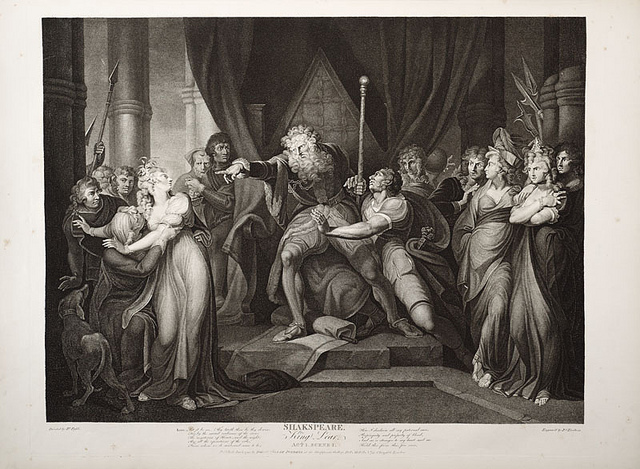 "The play begins by instantiating a vision of social lodge. A trumpet is sounded, and a coronet is borne into the land chamber, and then there follows in society of rank and precedence, the powers of the state: King Lear, his sons-in-law, the Dukes of Albany and Cornwall; and his daughters in the lodge of their ages. ('Albany' is the ancient and literary proper name of Scotland; 'Cornwall,' of the southwest of England. Together these sons-in-law demarcate the Britain Lear is before long to dismember.) Elaborate, ornate, imperial – as a madder and a wiser Lear will later on declare, 'Robes and furred gowns hide all' – the scene before u.s.a. is ane of opulent magnificence and insistent order. It is a scene, above all, of 'accommodated man,' of humanity surrounded with wealth and power, robes and furs, warmth, food, and attendants – the radical reverse of the victim the play's third act will supply, when Lear volition tell the naked and tattered 'Poor tom,'
[T]hou art the thing itself. Unaccommodated man is no more merely such a poor, bare, forked animal as one thousand art.
(three.4.96-97)
Unaccommodated man, and accommodated homo. As the play begins the audition is confronted with kingly ability in all its majesty, flesh patently accommodated with everything it tin can imagine or desire. At the eye of this world is the King. And nevertheless, when the Male monarch begins to speak, we are at one time made uneasy, if we are listening closely: 'Concurrently nosotros shall limited our darker purpose.' In a play in which one of the cardinal images will be sight and blindness, this is already a warning signal. What is the King'due south darker purpose? Goose egg less than the division of the kingdom, the willful creation of disorder:
Know that we have divided
In three our kingdom, and 'tis our fast intent
To milkshake all cares and business from our age,
Conferring them on younger strength while we
Unburdened crawl toward expiry…
Only this is opposite to everything that nosotros know nigh kingship. It is articulate not merely from the precepts and practice of Elizabeth and James but too from very Shakespearean example that the ideal for rulers demands unity, non division, a single rex, a strong ruler, and ane who is prepared to choose a public life over a private one. Whether the male monarch is Henry Five or Julius Caesar, this principle holds; that the King should understand that the obligation is to agree together the state and unify its people. Yet here we have a king who intends to violate every single one of these proven precepts – who volition attempt the physically and regally impossible, inviting his eldest daughters, 'this crownet part between you, and who volition also seek to escape the inescapable burden of morality 'to '[u]unburdened crawl toward death,' as if had regressed to the posture and position of a child.
Moreover, the entire scene has the quality of a fairy tale, and indeed of a well-rehearsed fairy tale: the king, the three daughters (two older and cruel, the youngest loyal, pure, and misunderstood) – there are no surprises hither. Nosotros know and expect that the elder daughters will be wicked flatterers, the youngest their victim. Their articulation business concern volition be the division of the kingdom.
This is a purposeful fall, a fall by choice. The map is already present, the lands partitioned, pending the completion of the ritual equally if the king has designed and planned it. Lear is testing what should need no test: the quality of nature and what is 'natural.' The whole play that follows volition deal with this vexed question, of nature and of the 'natural child.' What is a natural child"? Is nature what Alfred, Lord Tennyson, would telephone call 'Nature, reddish in tooth and claw,' the nature of pelican daughters, canis familiaris-hearted daughters, cannibals, and competitors? Or is nature a country akin to grace, a pattern of plentitude and guild, like the lands the Lear of this opening scene has in his keeping: 'With shadowy forests and with champaigns riched,/With plenteous rivers and wide-skirted meads.' Nature every bit the kingly emblem of fertility, club, harvest, and grace. Which?
Lear:
Tell me, my daughters –
Since at present nosotros will divest us both of rule,
Involvement of territory, cares of state –
Which of y'all shall we say doth beloved us near,
That we our largest bounty may extend
Where nature doth with merit challenge?…
This is hubris, overweening pride, and presumptuousness, not simply a violation of Lear's responsibilities every bit King and man, simply as well a tempering with the bonds of nature, equally his youngest daughter, Cordelia, well knows. And the replies of the two elderberry daughters, Goneril and Regan, to this love test accept a rehearsed quality, a smooth deceptive flow. The whole scene is stylized and formal, until Cordelia breaks its frame. Goneril's answer is plainly unequivocal:
Sir, I love you more than than words can wield the matter;
Dearer than eyesight, space, and liberty…
Eyesight, space, and liberty – all cardinal themes in the play, all elements of which Lear and his fellow sufferer Gloucester will be bereft by the play's end.
A love that makes breath poor and speech unable.
And Regan adds,
I am made of that self mettle equally my sister,
And prize me at her worth. In my true middle
I detect she names my very deed of beloved –
Only she comes too short…
Notice 'prize,' 'worth,' 'deed' – all economic terms, which should alert u.s. to the true nature of the elderberry daughter's thoughts. Words, these sisters say, cannot express their feelings. 'I am solitary felicitate/In your dear highness' love,' Regan concludes.
Having expended words in saying that they have no words, the sisters receive their segments of the dismembered kingdom. And then it is Cordelia's turn to speak:
Lear:
At present our joy,
Although our last and least…
……………………….
what tin you say to draw
A tertiary more opulent than your sisters? Speak.
Cordelia:
Zippo, my lord.
Lear:
Cipher?
Cordelia:
Lear:
Nothing volition come from goose egg. Speak again.
Cordelia:
Unhappy that I am, I cannot heave
My middle into my oral fissure. I love your majesty
According to my bond, no more nor less.
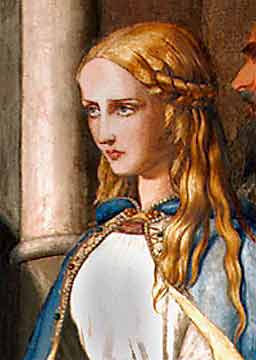 Cordelia – whose name comes from the word for 'heart' (the Latin cor, cordis) – declares that she loves her father according to the bond of parent and kid. This is the quintessence of the 'natural.' But Lear, whose language, like that of his elder daughters, has been sprinkled throughout the scene with legalisms, with cares and concern, involvement of territory, worth, deeds, and property, mistakes the natural for the unnatural, the bond of beloved for the bond of fiscal contract:
Lear:
So young and then untender?
Cordelia:
So young, my lord, and true.
Lear:
Let it be so. Thy truth so be thy dower…
If beloved is measureable by 'merit,' by property and 'wroth,' then Cordelia's natural claim of a bond begs no dowry, no reward. 'H]er price is fallen, as Lear will before long and bitterly tell her suitors. The inexpressible and immaterial is reduced to the merely material.
Like Desdemona earlier her, Cordelia gives voice to the choice of a married man over a father:
Why have my sisters husbands if they say
They love you lot all? Haply when I shall wed
That lord whose paw must take my plight shall deport
Half my honey with him, half my care and duty.
Her word 'plight' here is typically rich deployment of Shakespearean word economy: a husband will take on the risk together with the betrothal, the 'trothplight.' Both words are from the same root, significant 'pledge' or 'danger.' Merely Lear will non exist moved: 'Thy truth then exist thy dower' ('Nothing will come of nil.'). And, to the loyal supporter who would intervene: 'Come non between the dragon and his wrath.'
In this opening scene, in Cordelia'southward despairing counsel to herself – 'What shall Cordelia speak? Love and be silent' – we have the beginning of a highly significant dramatic and performative way in Shakespeare, what might exist chosen the rhetoric of silence. Some things cannot be said, cannot be given words. To abstain language in such cases is not a refusal of speech, like Iago'southward final words, but rather an acknowledgment of the limitations of language, and the place of the ineffable or the unutterable. The minor and silent claim of a love co-ordinate to her bond will distinguish Cordelia's language, and her silence, throughout the play. Like Hamlet in the court of Claudius, dismayed past a falseness of ceremony and the part-playing all around him, Cordelia refuses to play the game, refuses to involve herself in playacting and willful deception. While Hamlet makes use of theatricality every bit a trap, Cordelia occupies what might be called the vanishing point of theatricality. We may retrieve that Cordelia'south rigidity here is too pure a gesture, that she could curve, could compromise – only she, similar her sisters, is her male parent's daughter, stubborn and proud. Her motive in this moment seems obviously to disclaim bamboozlement, to assert, again, something that in her understanding needs no assertion: the true and natural relationship between parent and kid. Only in one case disrupted, this 'bail' is not restored until tragedy has overtaken both Lear and Gloucester.
Cordelia'southward rhetoric of silence will continue throughout the play, and will reach what is perhaps its about striking point when she herself becomes a status of nature, at the bespeak in deed iv (scene 17 in the Quarto text) when, beholding the ruined King, she will appear, in the words of an anonymous gentleman onlooker, similar '[south]unshine and pelting at once,' split between smiles and tears, incapable of speech because of her dear and pity. But nosotros will also see the tragic limitations of her silence, the capacity of silence to be radically misunderstood, and the way in which Cordelia overcomes it and returns to speech.
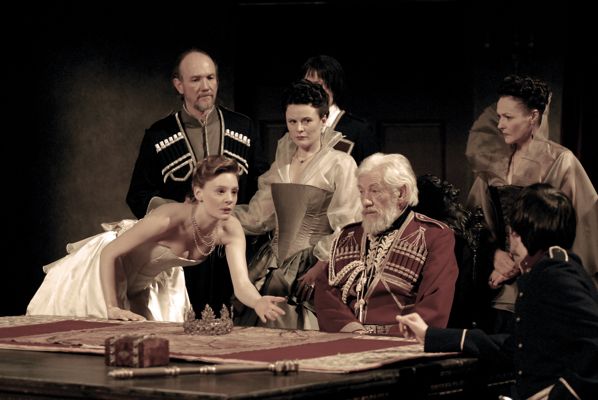 At this indicate in the play, yet, Cordelia's silence is an antidote to the unfeeling hypocrisy of Goneril and Regan, the 'glib and oily art' of their glozing spoken communication. Silence, enacted on the stage, also resists the Machiavellian twofacedness of Edmund, that principal rhetorician. When Lear in the latter part of the play is reduced to strings of repetitions ('Howl, howl, howl, howl!' as he discovers Cordelia's dead trunk; or 'Kill, kill, kill, kill, impale'; or closer to the theme of 'cypher' 'Never, never, never, never, never'), we experience another version of the rhetoric of silence, the acknowledgement of the unutterable, the literally unspeakable. Like the syntactical breakdown of Othello'southward language in the scene of his swooning fit, Lear'southward repeated iterations of the aforementioned word over and once more, without subject tor object, and without any rhetorical gesture of control, mark the very limit of linguistic communication every bit communication.
From the offset scene on, other characters will seek to evade the prevailing duplicity of language in even so another way, by disguising their voices. Thus Kent becomes the country man "Caius,' whose plainness of voice communication is so irritating to the Duke of Cornwall, and who puts on a mockingly ladylike language to endeavor to expose the follies of flattery and verbal 'accommodation' ('Sir, in good organized religion, in sincere verity,/Under th'assart of your great attribute,' and so on). The servile linguistic communication he mocks resembles that of Osric, the foppish courtier in Village, whose words were so fashionably contorted they required translation. In a like fashion Edgar, eschewing the ornate duplicities of the court, becomes not only 'Poor Tom,' the 'Bedlam beggar' with his nonsensical jingles and visions of fiends, but as well the rustic with the strange dialect who pretends to rescue the blind Gloucester at the bottom of Dover 'cliff.' Gloucester almost recognizes his disguised son past his voice – 'Methinks thy vox is altered;' 'Methinks you're better spoken' – and is hastily corrected by Edgar: 'You're much deceived. In zip am I changed/But in my garments.' Since Gloucester is blind, he cannot see that Edgar'south garments, alone, remain unchanged throughout the scene.
The dark side of the rhetoric of silence, the linguistic communication of limitation and the limitation of language, is that great yawning chasm of 'nothing' that pervades the play, emanating from the remarkable and encyclopedic outset scene. 'Nothing volition come of nothing' is Lear's threat, based on his interpretation of Cordelia'due south silence. And 'Nada will come of zilch' will become Lear's own living epitaph in the acts and scenes to come up. 'Nothing' – the opposite of 'everything,' of 'adaptation.'
'They told me I was everything; 'tis a lie, I am not ague-proof,' says Lear well-nigh the close of his tragedy. (iv.5.102). Both Lear and Gloucester volition brand the mistake of taking themselves for everything. Both are tortured by that haunting give-and-take 'nothing' until they get nothing. Afterward in the showtime deed Lear'southward Fool will ask his master, 'Can you make no use of zero, nuncle?' and will be told, Why no, boy, Nothing tin can be made of zippo.' But cipher is what Lear has left himself, in divesting himself of kingdom and power. Every bit the Fool points out, referring to the new Arabic numbers that were replacing Roman numerals, the innovation of the nought, the figure zip, from the Arabic word 'nothing,' meaning 'empty,' 'Now 1000 art an O without a figure. I am improve than thousand fine art, now. I am a fool; thousand art nothing.'
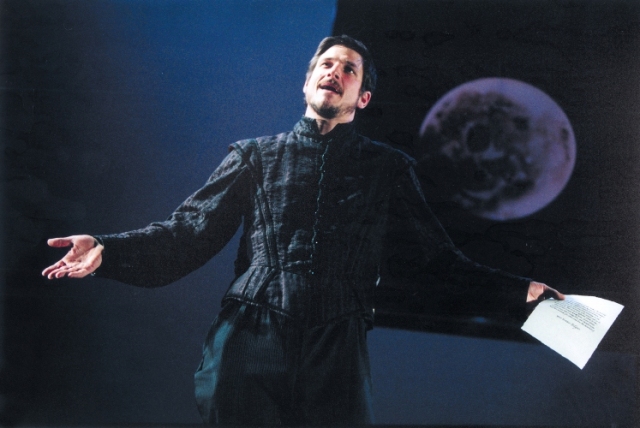 When he pretends to protect his father by theatrically 'concealing' a piece of paper, the bastard Edmund claims that he is reading 'nothing,' which is true, since what he has in his hand is a simulated letter he himself has fabricated to implicate his legitimate blood brother, Edgar. Merely Gloucester, similar Lear, volition autumn into the trap. 'The quality of naught hath not such need to hide itself,' he objects. The newspaper must be something. And so Gloucester make something of it, getting from Edmund the 'auricular assurance' that and then closely resembles Iago's as deceiving 'ocular proof' in Othello – evidence, in fact, of nothing at all. Gloucester ironically praises his son'south behavior every bit that of a '[l]oyal and natural boy' (2.1.83). Gloucester means 'according to nature,' just a 'natural' son (from the Latin filius naturalis and Heart French fils naturel) was an illegitimate kid, born outside of matrimony. Shortly nosotros will see the legitimate son, Edgar, stripped of his rightful place and forced for safety'due south sake to change his identity into that of the beggar 'Poor Tom,' declare, 'Edgar I nothing am' (2.ii.178). We could read this every bit 'I am not Edgar' only too 'As Edgar, I am nothing.' The play moves remorselessly from its first scene of 'everything' (adaptation, luxury, comfort, and security) toward a clear-eyed and scarifying contemplation of 'nothing.' And the immediate crusade is Lear's own lack of cocky-cognition.
At the close of the opening scene the audition hears Goneril and Regan, who accept flattered their father grossly throughout the public ceremony of the love test, at present speak of him privately every bit a senile fool. 'Yous see how total of changes his historic period is,' says Goneril, and Regan is quick to agree: 'Tis the infirmity of his age; yet he hath ever just slenderly known himself.' She is non entirely wrong, if Lear can commit the activeness with which he opens the play, the irreversible action that calls down his tragedy upon him. 'Only we shall retain/The name and all th'addition to a king.' To retain 'only the proper noun,' the title without the power, is of class incommunicable. Kent, the loyal friend and vassal, is to Lear in this play what Horatio is to Village, what Banquo is to Macbeth – an index of normality, a foil for the excesses of the tragic hero. Kent calls the abdication folly, and the rejection of Cordelia madness, and he addresses, direct and firmly, the question of retaining 'only the name':
Royal Lear,
Whom I accept e'er honoured equally my king,
Loved as my father, every bit my master followed,
Equally my keen patron idea on in my prayers –
'Royal Lear,' 'king,' 'father,' 'master,' 'patron' – these are the necessary social roles and costumes of accommodated man, and Lear rejects them all, earning Kent'south blunt acrimony. 'Be Kent unmannerly/When Lear is mad. What wouldst k do, old human?' and, 'To plainness honour'southward bound/When majesty falls to folly.' Thus once again in this great opening scene we hear a note that volition exist sounded repeatedly. Lear is already mad here, although non however in the sense of the frantic disorientation that will overtake him by the third act. He is metaphorically, though not yet literally, mad. And he is no longer King, patron, royal Lear. Instead he has become but – and impotently – an 'onetime human.' The aforementioned pointed reduction will take place again at the end of act 2, when Gloucester refers to Lear with customary respect as 'the Rex' – 'The Rex is in high rage' (two.ii.459) – and Cornwell and Regan dismiss him merely as the 'old man.' For in stripping himself of these necessary roles, and the powerful trappings of kingship, Lear also strips himself of dignity, fear, respect – and friends. 'Out of my sight!' he rails at Kent, and Kent, over again prophetically, answers, 'See better, Lear' (1.1.155-56). Lear'south moral incomprehension is every bit absolute in this opening scene as Gloucester's concrete incomprehension will be later in the play, and Lear divests himself not only of his kingdom, his girl Cordelia, and his roles as King and father, but also of those other crucial roles as primary and patron, for he divests himself of Kent. The faithful Earl of Kent is banished, his banishment ordained to take place on the sixth day, with a resonance of the adjournment of Adam from Eden. He departs with: 'Thus Kent, O princes, bids you all adieu; /He'll shape his sometime course in a land new.' Like Celia in As You Like It going forth into the Forest of Arden ('Thus go we in content/To freedom and not to banishment'), or Coriolanus defiantly rejecting Rome ('I banish you' [emphasis added]), Kent claims the comparative liberty of exile, when oppression and injustice inhabit the court; 'Freedom lives hence, and adjournment is here.' With the division of the kingdom and the rejection of Cordelia and Kent, Lear'southward Uk undergoes a fall. (Kent returns immediately in the disguise of a mutual man, doffing his exalted rank. 'How at present, what art thou?' the King volition demand of him, and he will respond simply, 'A man, sir.'
All appearance of order and rank has disappeared. The great allegorical procession that trailed across the stage – king, nobles, daughters, dependents – is broken upward, disrupted. Such a procession, a visual icon of royal power, would have been clearly recognizable to Shakespeare'southward audience as the sign of contemporary – early on modern – sequence and succession, however situated the events of the play might exist in the history of early Britain. The sumptuous trappings of civilization are revealed as fictive coverings, and the play's innate primitivism, which goes even further dorsum than Norman or Celtic United kingdom of great britain and northern ireland, begins to reveal itself. This is not, later on all, a civilized globe. It is a world of monster, cannibals, and heraldic conflict. 'Come not between the dragon and his wrath,' Lear commanded Kent as Kent tried to arbitrate on behalf of Cordelia (1.i.120). Lear is both the dragon, the sign of United kingdom of great britain and northern ireland from Norman times onward, and the wrathful king – a male monarch who thinks he has the power of an angry god. No sooner does he say this than the play is flooded with images of unnatural monsters, monsters that feed upon themselves and their young:
The roughshod Scythian,
Or he that makes his generation messes
To gorge his appetite…
(ane.ane.114-116)
Ingratitude, yard marble-hearted fiend,
More hideous when thou prove'st thee in a kid
Than the sea-monster –
(ane.iv.220-222)
How sharper than a serpent'due south tooth is it
To have a thankless child…
(1.4.251-252)
Humanity must perforce prey on itself,
Like monsters of the deep.
(Quarto, 16.48-49)
Lear and others now begin to speak of pelican daughters; of tigers, not daughters; of dog-hearted daughters; of abrupt-toothed unkindness, like a vulture; of nails that flay a wolfish visage. A whole cluster of monsters is summoned up, in event, by Lear's initial action in dividing his kingdom, and in wishing to do what no homo and certainly no king can do: to unburdened clamber toward death.
This marvelous, panoramic opening scene, then, poses almost all the issues and introduces almost all the images that volition serve to focus the play. notwithstanding the Lear plot is only 1 of the 2 major plots that intertwine in Rex Lear. What nosotros take been calling the 'opening scene' is framed past two episodes that involve the fundamental figures of Gloucester and his bastard son Edmund. The play is designed with a very clear symmetry: two old men, each with a loyal child he mistakenly considers disloyal (Cordelia and Edgar), and disloyal children or a child he at showtime thinks loyal and natural (Goneril, Regan, and Edmund). In fact, ane Restoration editor, Nahum Tate, dissatisfied with the tragic ending of the play, rewrote it to conclude with a marriage between Cordelia and Edgar. And lest nosotros call up this a curious aberration of those times, we should note that the Tate version of the play, 'reviv'd with alterations,' to quote his title folio, held the stage from 1681 to 1838, every bit the 'improv'd version of King Lear, correcting the barbarisms of Jacobean times.
The symmetries provided by these two plots, the Lear plot and the Gloucester plot, are not only dynastic or structural. Lear, whose mistake is a mental error, the error of misjudgment in dismembering his kingdom, is punished past a mental affliction, madness. Gloucester, whose sin is a concrete sin, lechery, is punished in the play by a physical affliction, blindness. As Edgar says bitterly to Edmund, 'The dark and cruel place where thee he got/Cost him his optics' (5.3.162-163). The blinding of Gloucester is besides, of form, a literal evocation of this imagined justness of penalization, an eye for an eye. The manifold mythic and literary associations of blindness, from Oedipus to Freud, link that status with sexual knowledge, with castration, and with 'insight.' (Equally Gloucester will observe ruefully, underscoring the paradox, 'I stumbled when I saw.')
The play presents two different paradigms of biblical suffering, juxtaposed and paralleled. Lear is a Chore-like character, a homo who has everything (family, wealth, honor) and loses everything. The mock trial in scene 13 (in the Quarto just) restages the story of Chore and his comforters, here played past the tragically inadequate figures of the Fool and 'Poor Tom.' Nosotros hear Lear, like Chore, quest perpetually for patience: 'You heavens, give me that patience, patience I need" (ii.2.437); 'I will exist the design of all patience.'I will say nothing.' (iii.2.36-37); 'I tin be patient, I can stay with Regan,/I and my hundred knights' (ii.2.395-393); 'I'll not suffer information technology' (i.three.5) – and so, two acts subsequently, 'Pour on, I will endure' (3.four.18). But if Lear is a Job, quick to anger and quick to rails against sky, Gloucester is a more passive and accepting Christian sufferer, a human who is willing to believe that ripeness is all, that men must endure their going hence, even every bit their coming here. Every bit if to emphasize the degree of his abnegation, Gloucester begins to speak of the 'kind gods' from the moment his eyes are put out.
The latter part of King Lear places an increasingly heavy accent on this emblematic Christian theme in linguistic communication and in staging. Cordelia is arguably the real 'Christ effigy' in the play, speaking of her 'father'south business organization' and making her final appearance in a gender-reversed Pieta, held in the arms of a grieving Lear. Some productions of the play have likewise emphasized Edgar's axiomatic Christ-like qualities; in Peter Brook's film (1971) Edgar is stabbed in the side with a spear as he cries out at the spectacle of death ('O k side-piercing sight!'). Yet as with all Shakespearean evocations of allegory, whether religious, mythological, or political, the Christian undertones and overtones in Lear work best when they are immune to augment the dramatic activity rather than displace it. The power of King Lear and its place in our cultural imaginary depend in a higher place all, at least for a modern audition, upon its depiction of a human story of love, suffering, and loss.
The gods mentioned in this play are as diverse equally the mythological strains that underpin it. The beginning mentions are of pagan gods; Lear swears by Apollo and appeals to 'the thunder-bearer' and to 'high-judging Jove' (2.2.392, 393). In 1606 Parliament passed 'An Human action to Restrain Abuses of Players'; information technology stipulated that 'no person or persons…in any stage play, interlude, prove, maygame, or pageant' might 'jestingly or profanely speak or apply the holy name of god or of Christ Jesus, or of the Holy ghost or of the Trinity.' Thus, swearing by the name of the Christian God was forbidden by police force. Yet the play moves inexorably toward the contemplation of a Christian solution. The pagan gods go at various times kind gods, clearest gods, simply gods – or, in i of the play's most famously despairing lines, gods every bit 'wanton boys.'
In fact, what we have in King Lear are non only ii modes of suffering and ii kinds of godhead but too ii conceptions of tragedy that are cited explicitly and made to play against each other. Familiar from earlier Shakespearean history plays, and notably from Richard III, these ii modes can be described, in autograph terms, every bit cyclical and linear, or as 'medieval' and 'early on modernistic.' As we take frequently noticed, 1 popular pattern for tragedy, as exemplified in the kinds of medieval literary works called 'falls of princes,' was that of the wheel of Fortune. Life was imagined – and often depicted in woodcuts and engravings – as a keen wheel. Each man'southward and each woman's life reached a betoken of greatest pinnacle, greatest prosperity, from which he or she would, ultimately, autumn.
We hear a nifty deal about this kind of tragedy in King Lear. The disguised Edgar speaks of what information technology is like to be 'at the worst,' at the lesser of Fortune's wheel, simply to detect that, since he tin can say he is at the lesser, he is non yet really there. (He is in fact immediately confronted with the spectacle of his blinded father, and is moved to observe, 'I am worse than e'er I was' (four.i.26). This is another clear example in the play of the rhetoric of silence, the unutterability of extremes in emotion.) Likewise the bearded Kent, finding himself ignobly identify in the stocks – a penalization that angers his master, Lear, because it is an insult, a disregard of rank – resigns himself to the necessity of patience: 'Fortune, skillful night;/Smile once more; plow thy wheel' (2.2.157-158). Lear's Fool, too, believes in this kind of cycle. He sees that his own prospects are dependent upon the vagaries and vicissitudes of Fortune: 'Let go thy agree when a great cycle runs down a loma, lest it break thy cervix with following; but the slap-up one that goes upwardly, allow him depict thee subsequently' (2.2.238-240). And as he lies dying at the finish of the play even the bastard Edmund, who had cynically observed, 'The younger rises when the old doth fall' (iii.3.22), accepts with fatality his reversal of fortune: 'The bicycle is come full circle. I am hither.' (5.3.164).
This notion of Fortune's bicycle is omnipresent in the play, but information technology is consistently in tension with another pattern, one frequently associated with Christianity, simply also with tragedy in its classical course: the idea of the fortunate fall. 'The gods throw incense on our sacrifices;' private human suffering and human loss are but aspects of the quest for a larger cognition of the nature of humanity and mortality. Thus the idea of exemplary sacrifice – Christ died for the sins of mankind – is sutured to the dramatic action, at the aforementioned time that information technology is naturalized and humanized. Both Lear and Gloucester 'die' in the play – indeed each dies not once merely twice, and each is 'reborn.' Gloucester believes that he has leapt from Dover 'cliff' and has been miraculously preserved to life; Lear in the fourth act dies out of his madness and into fresh garments, out of the grave and into the world again. When they die a second time – when they die 'for existent,' and then to speak – is the second (literal) 'death' probable to be any more than final than the starting time (symbolic) one? The play itself is 'reborn' (today we often say 'revived') each time it is performed. One of the functions of Jacobean tragedy is to have this exemplary and educative course: to present us with cracking figures who die for our sins and make mistakes that could exist ours, and whose tragedies have identify and then that ours will not, or need non. Literary tragedy is in this formal sense a scapegoat, substitute, or safety valve. Its cultural value is not only aesthetic but as well ameliorative and apotropaic, warding off danger.
But the tragedy of King Lear begins at the other end of the scale, not with the supernatural only with the natural. As we accept seen, Cordelia'south claim of a natural 'bond' between parent and child is juxtaposed to an paradigm of the 'natural' in its most anarchic and destructive class, in the person of Edmund, the natural, or bastard, son of the Knuckles of Gloucester. Edmund's villainy is not equated with his bastardy, although the range of meanings of 'natural' offers an effective amplification of the serious rumination on the nature of 'nature' throughout the play. Philip Falconbridge, the 'Bastard' in Rex John, is that play's martial and patriotic centre, far more heroic than his conservative (and 'legitimate') blood brother, Robert. The great voice communication on 'bastardy' and baseness should rather be compared to Richard of Gloucester'south comparably energetic voice communication on 'deformity' at the get-go of Richard III. In both cases the Machiavellian speaker seduces the audience, using his supposed deficiency as both a rhetorical excuse for aberrancy and a gauntlet thrown downward daringly to claiming the condition quo. Edmund is a shut relation of Iago [MY NOTE: Much more than on Edmund from Harold Bloom in after posts] and of Richard Iii in his antipathy for what he regards as passive sentimentalism. Like them he is a Machiavel and Vice figure, a character who draws force from his own contrariness. Non for him the quondam-fashioned view that 'our stars' govern our behavior: 'I should accept been what I am had the maidenliest star in the empyrean twinkled on my bastardizing' (i.2.119-121). He revels in disorder, takes pleasure in anarchy. In the early part of the play, when all around him other characters either brainstorm to uncertainty their own identities or feel it prudent to conceal them, Edmund alone is never doubtful. His masterful manifesto is addressed to Nature, the goddess he elects as the patroness of natural children, the children of disorder:
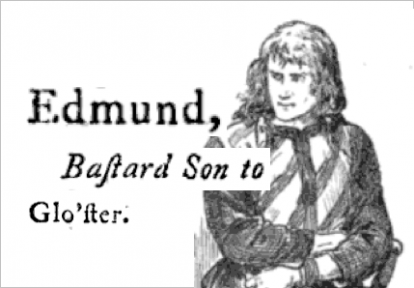 Thou, nature, art my goddess. To thy police
My services are bound. Wherefore should I
Stand in the plague of custom and permit
The marvel of nations to deprive me
For that I am some twelve or fourteen moonshines
Lag of a brother? Why 'bastard?' Wherefore 'base of operations,'
When my dimensions are as well compact,
My mind every bit generous, and my shape as true
As honest madam's issue? Why brand they us
With 'base of operations,' with 'baseness, bastardy – base, base' –
Who in the lusty stealth of nature take
More than limerick and fierce quality
Than doth within a dull, stale, tired bed
Go to th' creating a whole tribe of fops
Got 'tween a slumber and wake? Well so,
Legitimate Edgar, I must accept your land.
Our father's beloved is to the bounder Edmund
As to th' legitimate. Fine give-and-take, 'legitimate.'
Well, my legitimate, if this letter speed
And my invention thrive, Edmund the base
Shall to thursday' legitimate. I grow, I prosper.
Now gods, stand upwards for bastards!
The linguistic communication of energetic and entrepreneurial 'prosperity' ('I abound, I proper') seems to counter, and to replace, the repressive economics of Lear's dear examination ('deeds,' 'worth, 'etc.). It is almost equally if Lear'southward rejection of the 'true' daughter, Cordelia, has brought forth this outburst, so that prosperity at present resides not amongst the orderly processes of rule and kingship simply instead in a celebration of the anarchy of sexual practice and law. The adjacent invocation to Nature we hear will exist Lear'south curse called downwards upon Goneril: 'Into her womb convey sterility.' (ane.4.240).
Nature goes from pure fecundity to amanuensis of barrenness, and we might find hither how very quickly it is that Lear, too, falls. Even inside that emblematic first scene his autumn from beloved to wrath is astonishingly swift, and the conference of the disaffected daughters afterward confirms the audience'due south misgivings. Past the terminate of the starting time act the King is nil but an 'Idle quondam man,/That yet would manage those authorities/that he hath given away!' (Quarto, iii.16-18) – at to the lowest degree in Goneril's view. Lear is now for the first time joined onstage by his Fool. It is no accident that the fool appears just at the moment when Lear has begun to human activity like a fool. We will see shortly the degree to which this sublime Fool acts as a mirror for the Male monarch. Lear'south self-stripping, of lands, of friends, of his treasured daughter, is now converted into a stripping by his elder daughters,, so that he is, for the first time in the play, (and, again, quite early), reduced to a tragic quest for self – all the more tragic because it is performed as a piece of unbecoming foolery, a piece of mumming, what Goneril calls one of his 'new pranks":
Does any hither know me? This is not Lear.
Does Lear walk thus, speak thus? Where are his eyes?
……………………………………
[Ha], waking? 'Tis not and then.
Who is information technology that can tell me who I am?
'Lear's shadow,' replied the Fool. Eyes, speaking, and waking are all familiar and indicative themes, and from this point the play will proliferate not only images of this kind merely also insistent questions of identity. Goneril, the resistant audience to this poignant scene, is determined to strip her father of half his bellboy knights, and it is this issue that calls down upon her his expletive, delivered at the stop of Act I. Once again, this must seem early to united states, in view of the blueprint of the usual tragic autumn. Hither is Lear:
Hear, nature; hear, dear goddess, hear:
Suspend thy purpose if one thousand didst intend
To make this animal fruitful.
Into her womb convey sterility.
Dry out up in her the organ of increase,
And from her derogate body never spring
A babe to honour her…
Lear wishes upon his eldest daughter a fate that will exit her non only without a child just also without an heir. Since she has inherited part of his kingdom, this is a wish that, if granted, would bring to an end the rule he has granted her. One of the many connotations of the word 'zilch' in this period was a slang reference to the female sexual organs (compare Hamlet's lines on the 'no thing' that lies 'between maids' legs). Thus Lear'due south intemperate words to Cordelia ('Nil will come of nothing') are now transposed into his concrete expletive upon Goneril – that cypher (no kid) should come of her 'no thing.')
——————————–
——————————-
And that'southward what Marjorie Garber had to say about Deed Ane – thoughts?
My adjacent mail service: Thursday evening/Fri morning – more on Act I.
Source: https://theplaystheblog.wordpress.com/2013/07/23/nothing-will-come-from-nothing-speak-again/
0 Response to "Nothing Will Come of Nothing Speak Again"
Post a Comment